


In 2024, under the unfavorable background of global economic growth slowdown and weak international market demand, China’s trade in traditional Chinese medicine commodities ran smoothly, of which the continuous expansion of imports of raw materials of traditional Chinese medicine commodities was the main driving force to catalyze the steady progress of the import and export trade of traditional Chinese medicine.2025 In the first quarter of the year, the import and export of traditional Chinese medicine products in China declined to varying degrees at both ends of the foreign trade and import and export trade, of which health care products were in a sharp decline.
In the first half of 2025, the import and export trade of traditional Chinese medicine products totaled 3.97 billion U.S. dollars, a year-on-year decline of 5.5%. Among them, exports amounted to 2.54 billion U.S. dollars, a year-on-year decline of 5.6%; imports amounted to 1.43 billion U.S. dollars, a year-on-year decline of 5.2%, imports declined in comparison with the first quarter of the easing of the rate of decline in exports than the first quarter of the expansion of the rate of decline. Overall, China’s foreign trade in traditional Chinese medicine has stabilized the basic plate and shown strong resilience in the face of multiple unfavorable factors such as the turbulent international political and economic environment and the increased instability of the industrial chain supply chain.
Import and export trade of traditional Chinese medicine in the first half of 2025
Export
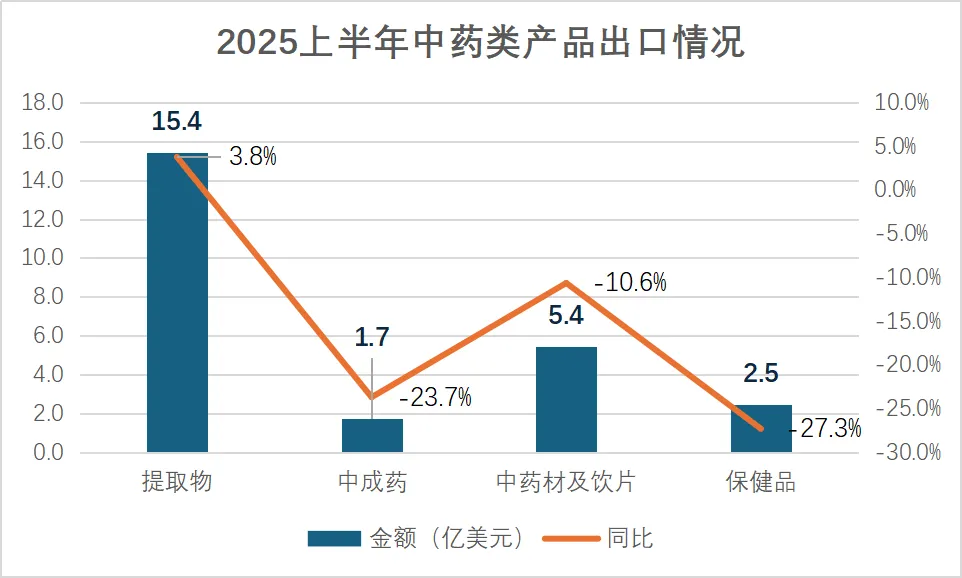
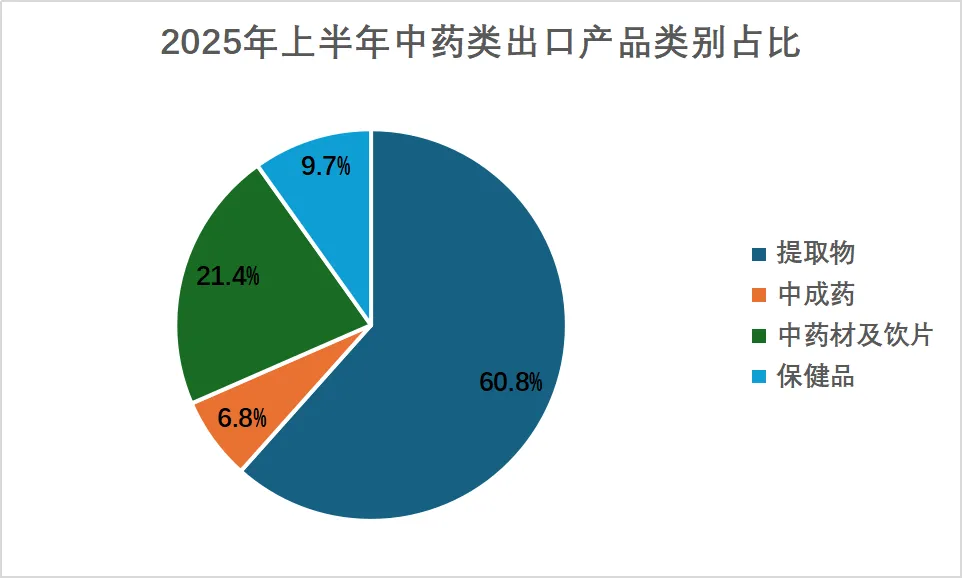
In the first half of 2025, China’s exports of traditional Chinese medicine products totaled 2.54 billion U.S. dollars, down 5.6% from 2.69 billion U.S. dollars in the same period last year. In fact, in recent years, the foreign trade import of traditional Chinese medicine has been growing rapidly, while the growth of export has been slowing down gradually, and the export has even entered into a negative growth trend in 2023 and 2024, falling by 3.1% and 2.7% respectively. It can be seen that China’s foreign trade in traditional Chinese medicine products has gradually from the plant extracts as the representative of the raw material products export-driven to the Chinese herbal medicine as the representative of the raw material products import-driven. In the future, the import of high-quality Chinese medicine raw materials will be the development trend of foreign trade in Chinese medicine.
Plant extracts
Plant extracts, as the mainstay of exports of traditional Chinese medicine products, exported 1.54 billion U.S. dollars in the first half of 2025, up 3.8% year-on-year, reversing the decline of 14.5% in the same period last year. From the perspective of major export markets, the United States, India and Japan are the top three markets for China’s plant extract exports in the first half of the year. The U.S. perennial stable in China’s exports of plant extracts of the largest market, exports far more than other countries and regions, China’s production of plant extracts are heavily used in the production of its dietary supplements. 2025 first half of the year, China’s exports to the U.S. extracts for 320 million U.S. dollars, a year-on-year rise of 7.7%, accounting for 20.9% of China’s total exports of extracts. The second and third ranked markets of Japan and India both had exports of around $150 million. Over the past three years (2022-2024), China’s extract exports to Japan has maintained a steady growth trend, the first half of this year, China’s exports of extracts to Japan rose 15.9% year-on-year, exports amounted to $153 million. The Indian market in the past three years (2022-2024) in China’s extract exports in the global market continued to rise, accounting for 9.0% from 5.3% growth. In the first half of this year, China’s extract exports to India rose 13.8% year-on-year, with an export value of $156 million, mainly due to the oleoresin exports rose sharply by 98.5% compared with the same period last year.
From the point of view of segmentation, menthol, stevia extract, citrus essential oil, Citrus sinensis extract, eucalyptus oil, silymarin extract, ginkgo biloba extract, licorice extract and other large varieties are the main force pulling the export of animal and plant extracts. Among them, last year’s exports grew at a high rate of 36.8% of menthol, in the first half of this year, the export growth rate slowed down sharply, an increase of 5.4% year-on-year, the export value of about 100 million U.S. dollars.
Chinese Herbal Medicines and Drinking Tablets
In the first half of 2025, the export performance of Chinese herbal medicines and drinking tablets was slightly sluggish, with the export value amounting to USD 540 million, down 10.6% year-on-year. In fact, due to the increasing domestic demand for Chinese herbal medicines and the weak demand in the international market, China’s exports of Chinese herbal medicines and drinking tablets have already dropped by 6.7% and 5.8% in 2023 and 2024 respectively, showing a slow shrinkage in general.
In terms of export markets, the Asian market remains the major export market for Chinese herbal medicines and tablets in the first half of 2025. Japan, South Korea, Taiwan, China, Hong Kong and Vietnam are the top five export markets for Chinese herbal medicines and drinking tablets in China, occupying 65.7% of the market share. Over the past three years (2022-2024), China’s exports of Chinese herbal medicines and tablets to Japan have continued to grow, with three-year growth rates of 11.4%, 15.4% and 5.8% respectively. In the first half of this year, Japan remained steadily the largest export market for Chinese herbal medicines and drinking tablets in China, with exports amounting to 130 million U.S. dollars, but down 20.3% compared to the same period last year, with a market share of 23.3%, of which exports of Semen Xanthi fell by 17.3% compared to the same period last year. Exports to South Korea fell by 3.9% and 2.0% in 2023 and 2024, respectively. In the first half of this year, China’s exports of Chinese herbal medicines and slices to South Korea fell again by 6.6% year-on-year, with a value of US$68.9 million and a market share of 12.7%, mainly due to a significant drop of 47.8% in the exports of antler velvet and its powder compared with the same period last year. Exports to Hong Kong, China and Taiwan, China were around 60 million U.S. dollars, down 2.5% and 13.4% respectively.
ASEAN as China’s traditional important regional market for Chinese herbal medicines and tablets, China’s exports to it continued to decline at a high rate from 2023, down 20.3% and 30.5% in the past two years. Among them, Vietnam declined significantly, with the export value in 2024 only 38.5% of that in 2022. In the first half of this year, the country’s exports to ASEAN amounted to $100 million, which was only 27.6% of the annual export value in 2022, and also dropped by 2.6% compared with the same period in 2024. Three of the top five countries with larger exports have experienced negative growth, namely Vietnam, Malaysia and Singapore, of which Vietnam 2025 saw a 14.4% year-on-year decline in the first half of the year, mainly due to the export of wolfberries fell sharply by 52.2% compared with the same period last year. But at the same time, it is worth noting that in the first half of 2025, China’s exports of Chinese herbal medicines and tablets to Cambodia, Myanmar and Laos showed super-high growth, although the overall export value was not large, but the increase was as high as 196.6%, 683.3% and 168.9%, respectively.
From the perspective of segmentation, in the first half of 2025, the top five varieties of Chinese herbal medicines and tablets exported from China were cinnamon, wolfberry, ginseng, angelica and betel nut. Cinnamon and wolfberry fell 34.3% and 3.3% respectively in 2024, while ginseng and angelica grew 3.1% and 25.0% respectively in 2024, but in the first half of this year, the exports of these four varieties fell to varying degrees.Since 2020, China’s exports of betel nut have continued to grow at an ultra-high rate, with the export value growing from $226,000 in 2020 to 19.51 million U.S. dollars, the average annual compound growth rate of up to 143.9% during the five years. 2025, the first half of the year, betel nut exports continued to grow 114.5% year-on-year, exports amounted to 18.86 million U.S. dollars, only the first half of the year exports reached 96.7% of last year’s annual exports from last year’s fifteenth largest export varieties of the position of the fifth position jumped up to the momentum of export growth is still strong.
Proprietary Chinese Medicines
In the first half of 2025, China’s exports of proprietary Chinese medicines amounted to only 170 million U.S. dollars, down significantly from 230 million U.S. dollars in the same period last year, a drop of 23.7%. From the perspective of export market, the top five export markets of pCms are Hong Kong, China, Nigeria, the United States, Macao, China and Indonesia. Hong Kong, China is still the largest export market, exports of 60.11 million U.S. dollars, compared with the same period last year, down 42.4%, market share of 35%. The top five export markets, only the United States and Macao, China, to achieve positive growth, respectively, compared with the same period last year, an increase of 9.9% and 44.3%, exports to Indonesia, Nigeria, respectively, fell 35.4% and 12.5%.
From the perspective of segmentation, the main export products of pCms are classic varieties such as Pientzehuang, Qingliang Oil, Angong Niuhuang Pill and Baiyao. Among them, Qingliang Oil, Angong Niuhuang Pill, Chinese medicinal wine and Baiyao realized different degrees of growth, and Angong Niuhuang Pill and Baiyao grew significantly by 106.9% and 125.0% respectively. The export of Pientzehuang, on the other hand, dropped 70.3% year-on-year, especially the export to Hong Kong, China and Canada dropped 98% and 100% year-on-year respectively.
Health Care Products
At present, health care products are special in the customs statistics system, mainly including fish oil and cod liver oil, bee products and bird’s nest, vitamins and mineral preparation products are not counted. In addition, many health care products are exported in the form of food, which is also not included under health care products. The data on trade in health care products in this paper are incomplete statistics.
In 2023 and 2024, China’s exports of health care products achieved an increase of 42.2% and 20.9%, respectively, and in the first half of 2025, exports decreased by 27.3% year-on-year, with an export value of 250 million U.S. dollars. In terms of export markets, the U.S., South Korea, Australia, Canada and Chile are the top five markets for health care exports, with exports to the U.S., Australia and Chile declining by 22.4%, 38.4% and 80.3% respectively, which is the main factor for the overall decline in health care exports. Exports to South Korea and Canada, on the other hand, grew by 4.8% and 5.6% respectively, but the growth rate was significantly lower than that of 46.6% and 78.1% in the same period in 2024.
From the point of view of segmentation, the main export products of health care products for fish oil and cod liver oil, bee products and bird’s nest, etc., of which bird’s nest exports in the first half of this year grew as high as a staggering 4,140.9%, mainly due to the substantial growth in exports to Malaysia, China Macao, Hong Kong, China.
Imports
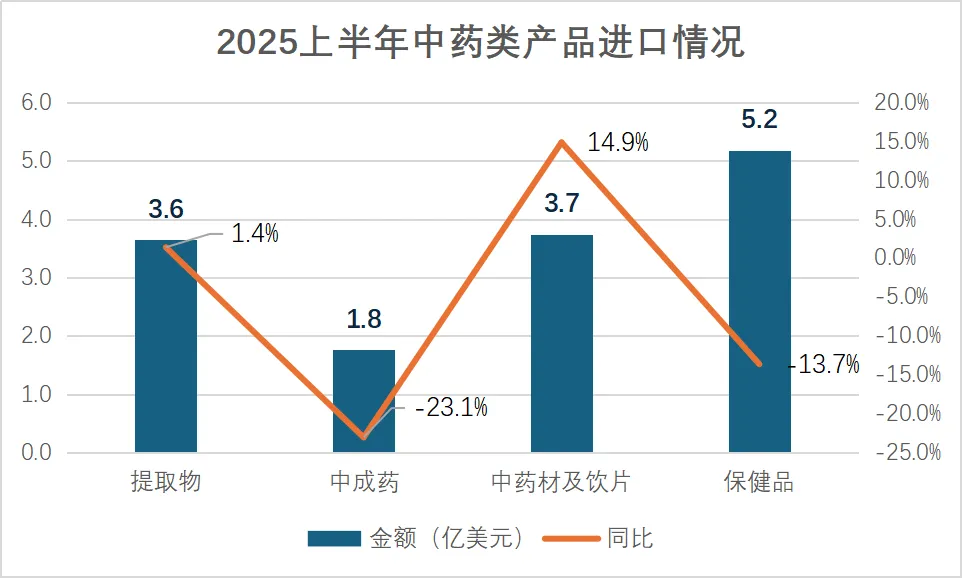
In the past five years, China’s imports of traditional Chinese medicine products have been on an overall expanding trend, with total imports growing from US$1.66 billion in 2020 to US$3.10 billion in 2024, representing a compound annual growth rate of 16.9%. However, in the first quarter of 2025, imports of Chinese medicine products declined by 8.4% year-on-year, and in the first half of 2025, they also dropped by 5.2% compared with US$1.51 billion in the same period last year, with total imports amounting to US$1.43 billion.
Plant Extracts
In the first half of 2025, the import value of plant extract products amounted to 360 million U.S. dollars, an increase of 1.4% year-on-year, a slight decline from the same period last year’s growth rate of 7.6%, but the overall trend is still rising.
From the perspective of import market, in the first half of 2025, China’s plant extract products imported the top three markets are India, the United States, Brazil. India is the largest source of imports of plant extracts in China, accounting for 18.7% of the market share, imports of 68.04 million U.S. dollars, but compared with the same period last year fell by 16.2%, of which menthol imports fell by 9.3% compared with the same period last year. The United States ranked as the second largest source of imports of plant extracts in China, with imports of 61.34 million U.S. dollars, an increase of 4.9% year-on-year, the same period last year, 1.5% negative growth has rebounded, mainly due to the imports of orange oil over the same period last year, a sharp rise of 30.8%. Brazil in 2024 with a substantial growth of 57.1% ranked China’s seventh largest source of plant extract imports, imports of 28.67 million U.S. dollars. In the first half of this year, China’s imports of extracts from Brazil rose sharply by 85.9% over the same period last year, with imports amounting to $30.41 million, already exceeding the level of the whole year of 2024, of which imports of orange oil rose sharply by 71.6% over the same period last year. In addition, China’s imports of extracts from Uzbekistan in 2024 showed explosive growth, with a growth rate of 84.1%, the first half of 2025 is 33.7% lower than the same period last year, imports of only $ 18.19 million, only up to the level of 33.6% of last year, mainly due to the imports of licorice liquid juice and extracts fell sharply by 57.8% compared with the same period last year.
From a segmentation point of view, essential oil products are the mainstay of imports, menthol, orange oil, peppermint oil, lemon oil, white lemon oil, peppermint oil, cinnamon oil and other essential oils accounted for nearly 50% of the first half of 2025 extract imports.
Chinese herbal medicines and tablets
Over the past five years, imports of Chinese herbal medicines and tablets have continued to grow, from $282 million in 2020 to $645 million in 2024. imports of Chinese herbal medicines and tablets products grew steadily again in the first half of 2025, with imports reaching $370 million, a year-on-year increase of 14.9%.
In terms of import markets, the top five import markets for Chinese herbal medicines and tablets in the first half of 2025 were Indonesia, Canada, New Zealand, Myanmar and South Korea. Indonesia continued to be the top importer of Chinese herbal medicines and tablets from China, with imports reaching US$95.19 million, up 76.8% from the same period last year, occupying 25.5% of the market share and far exceeding other markets, mainly due to a substantial increase of 102.7% in imports of cardamom from the same period last year. China’s imports of Chinese herbal medicines and tablets from Canada fell by 36.2% in 2024, ranking the sixth largest source of imports, but in the first half of this year rose sharply by 95.2% year-on-year, with imports amounting to 57.1 million U.S. dollars, which has already exceeded last year’s annual total imports and climbed up to the second position, mainly due to the imports of American ginseng, which rose sharply by 97.2% compared with the same period of last year. China’s imports of Chinese herbal medicines and tablets from New Zealand increased by 13.1% year-on-year in 2024, but fell by 18.7% year-on-year in the first half of this year, with the import value amounting to only 46.77 million U.S. dollars, mainly due to the import of antler velvet and its powder dropping by 18.8% compared with the same period last year. Imports from Myanmar and South Korea amounted to US$29.5 million and US$24.47 million respectively, up 1.6% and 31.6% from the same period last year.
In terms of segmentation, the main imported categories are American ginseng, antler velvet, cardamom, nutmeg, cloves and ginseng, etc., which are mainly domestic scarce or precious and fine medicinal herbs. The varieties with large increase in imports include American ginseng, cardamom and saffron.
Proprietary Chinese Medicines
In 2024, China’s imports of proprietary Chinese medicines amounted to USD 470 million, a year-on-year increase of 9.6%, but in the first half of this year, the year-on-year decline of 23.1%, with imports amounting to only USD 180 million. From the perspective of the import market in the first half of 2025, Hong Kong, China, Germany and Taiwan are the top three markets for imports of proprietary Chinese medicines products. 260 million U.S. dollars of proprietary Chinese medicines were imported from Hong Kong, China, in 2024, occupying 55.3% of the market, and imports in the first half of this year amounted to 110 million U.S. dollars, a year-on-year decline of 15.0%, but the market share expanded to 64%. The second largest import market is Germany, with imports of $30.74 million, down 56.4% compared to the same period last year, and a shrinking market share of 17.5%, but its year-on-year growth in 2024 was a whopping 25.9%, with a market share of 30.1%. Imports from Taiwan, China are different, on the basis of 32.9% year-on-year growth in 2024, a sharp increase of 140.7% in the first half of this year, imports reached 17.65 million U.S. dollars, has reached the level of 86.1% of the whole of last year.
Health care products
In 2024, China’s imports of health care products amounted to US$1.27 billion, a year-on-year increase of 9.9%, and imports amounted to 66,000 tons, a significant increase of 52.7%, which can be seen in the domestic consumer’s strong demand for health care products. However, in the first half of 2025, imports of health care products fell 13.7% year-on-year, with imports amounting to $520 million, reaching only 40.9% of last year’s annual level.
From the perspective of import market, in the first half of 2025, the top three markets for health care imports were Indonesia, Malaysia and Peru, accounting for 61.1% of total imports, with a high degree of import concentration. Indonesia steadily ranked as the largest source country for imports, with imports amounting to USD 180 million, a year-on-year decrease of 17.2%, mainly due to a significant drop in the imports of bird’s nests compared to the same period last year. Imports from Malaysia amounted to US$73.21 million, down 33.9% compared with the same period last year, mainly due to the sharp decline in imports of bird’s nest and fish oil products. Notably, imports from Peru amounted to US$61.85 million, a staggering year-on-year increase of 5,418.9%, mainly due to the ultra-substantial growth in imports of fish oil (except cod liver oil).
In terms of segmentation, bird’s nest and fish oil are the largest varieties of imports, far exceeding other categories, with imports in the first half of the year amounting to US$250 million and US$240 million respectively, accounting for 48.9% and 46.3% of the imports of health care products, but down 21.1% and 5.9% respectively compared with the same period last year. Seal oil is the third largest species, imports of 17.84 million U.S. dollars, an increase of 21.1% over the same period last year.

Plant Extracts
In the first half of 2025, the import value of plant extract products amounted to 360 million U.S. dollars, an increase of 1.4% year-on-year, a slight decline from the same period last year’s growth rate of 7.6%, but the overall trend is still rising.
From the perspective of import market, in the first half of 2025, China’s plant extract products imported the top three markets are India, the United States, Brazil. India is the largest source of imports of plant extracts in China, accounting for 18.7% of the market share, imports of 68.04 million U.S. dollars, but compared with the same period last year fell by 16.2%, of which menthol imports fell by 9.3% compared with the same period last year. The United States ranked as the second largest source of imports of plant extracts in China, with imports of 61.34 million U.S. dollars, an increase of 4.9% year-on-year, the same period last year, 1.5% negative growth has rebounded, mainly due to the imports of orange oil over the same period last year, a sharp rise of 30.8%. Brazil in 2024 with a substantial growth of 57.1% ranked China’s seventh largest source of plant extract imports, imports of 28.67 million U.S. dollars. In the first half of this year, China’s imports of extracts from Brazil rose sharply by 85.9% over the same period last year, with imports amounting to $30.41 million, already exceeding the level of the whole year of 2024, of which imports of orange oil rose sharply by 71.6% over the same period last year. In addition, China’s imports of extracts from Uzbekistan in 2024 showed explosive growth, with a growth rate of 84.1%, the first half of 2025 is 33.7% lower than the same period last year, imports of only $ 18.19 million, only up to the level of 33.6% of last year, mainly due to the imports of licorice liquid juice and extracts fell sharply by 57.8% compared with the same period last year.
From a segmentation point of view, essential oil products are the mainstay of imports, menthol, orange oil, peppermint oil, lemon oil, white lemon oil, peppermint oil, cinnamon oil and other essential oils accounted for nearly 50% of the first half of 2025 extract imports.
Chinese herbal medicines and tablets
Over the past five years, imports of Chinese herbal medicines and tablets have continued to grow, from $282 million in 2020 to $645 million in 2024. imports of Chinese herbal medicines and tablets products grew steadily again in the first half of 2025, with imports reaching $370 million, a year-on-year increase of 14.9%.
In terms of import markets, the top five import markets for Chinese herbal medicines and tablets in the first half of 2025 were Indonesia, Canada, New Zealand, Myanmar and South Korea. Indonesia continued to be the top importer of Chinese herbal medicines and tablets from China, with imports reaching US$95.19 million, up 76.8% from the same period last year, occupying 25.5% of the market share and far exceeding other markets, mainly due to a substantial increase of 102.7% in imports of cardamom from the same period last year. China’s imports of Chinese herbal medicines and tablets from Canada fell by 36.2% in 2024, ranking the sixth largest source of imports, but in the first half of this year rose sharply by 95.2% year-on-year, with imports amounting to 57.1 million U.S. dollars, which has already exceeded last year’s annual total imports and climbed up to the second position, mainly due to the imports of American ginseng, which rose sharply by 97.2% compared with the same period of last year. China’s imports of Chinese herbal medicines and tablets from New Zealand increased by 13.1% year-on-year in 2024, but fell by 18.7% year-on-year in the first half of this year, with the import value amounting to only 46.77 million U.S. dollars, mainly due to the import of antler velvet and its powder dropping by 18.8% compared with the same period last year. Imports from Myanmar and South Korea amounted to US$29.5 million and US$24.47 million respectively, up 1.6% and 31.6% from the same period last year.
In terms of segmentation, the main imported categories are American ginseng, antler velvet, cardamom, nutmeg, cloves and ginseng, etc., which are mainly domestic scarce or precious and fine medicinal herbs. The varieties with large increase in imports include American ginseng, cardamom and saffron.
Proprietary Chinese Medicines
In 2024, China’s imports of proprietary Chinese medicines amounted to USD 470 million, a year-on-year increase of 9.6%, but in the first half of this year, the year-on-year decline of 23.1%, with imports amounting to only USD 180 million. From the perspective of the import market in the first half of 2025, Hong Kong, China, Germany and Taiwan are the top three markets for imports of proprietary Chinese medicines products. 260 million U.S. dollars of proprietary Chinese medicines were imported from Hong Kong, China, in 2024, occupying 55.3% of the market, and imports in the first half of this year amounted to 110 million U.S. dollars, a year-on-year decline of 15.0%, but the market share expanded to 64%. The second largest import market is Germany, with imports of $30.74 million, down 56.4% compared to the same period last year, and a shrinking market share of 17.5%, but its year-on-year growth in 2024 was a whopping 25.9%, with a market share of 30.1%. Imports from Taiwan, China are different, on the basis of 32.9% year-on-year growth in 2024, a sharp increase of 140.7% in the first half of this year, imports reached 17.65 million U.S. dollars, has reached the level of 86.1% of the whole of last year.
Health care products
In 2024, China’s imports of health care products amounted to US$1.27 billion, a year-on-year increase of 9.9%, and imports amounted to 66,000 tons, a significant increase of 52.7%, which can be seen in the domestic consumer’s strong demand for health care products. However, in the first half of 2025, imports of health care products fell 13.7% year-on-year, with imports amounting to $520 million, reaching only 40.9% of last year’s annual level.
From the perspective of import market, in the first half of 2025, the top three markets for health care imports were Indonesia, Malaysia and Peru, accounting for 61.1% of total imports, with a high degree of import concentration. Indonesia steadily ranked as the largest source country for imports, with imports amounting to USD 180 million, a year-on-year decrease of 17.2%, mainly due to a significant drop in the imports of bird’s nests compared to the same period last year. Imports from Malaysia amounted to US$73.21 million, down 33.9% compared with the same period last year, mainly due to the sharp decline in imports of bird’s nest and fish oil products. Notably, imports from Peru amounted to US$61.85 million, a staggering year-on-year increase of 5,418.9%, mainly due to the ultra-substantial growth in imports of fish oil (except cod liver oil).
In terms of segmentation, bird’s nest and fish oil are the largest varieties of imports, far exceeding other categories, with imports in the first half of the year amounting to US$250 million and US$240 million respectively, accounting for 48.9% and 46.3% of the imports of health care products, but down 21.1% and 5.9% respectively compared with the same period last year. Seal oil is the third largest species, imports of 17.84 million U.S. dollars, an increase of 21.1% over the same period last year.