


En 2024, bajo el contexto desfavorable de la desaceleración del crecimiento económico global y la débil demanda del mercado internacional, el comercio chino de productos tradicionales de medicina china se desarrolló sin problemas, siendo la expansión continua de las importaciones de materias primas para estos productos el principal impulso que impulsó el progreso constante del comercio de importación y exportación de medicina tradicional china. En 2025, durante el primer trimestre del año, las importaciones y exportaciones de productos de medicina tradicional china en China disminuyeron en diversos grados tanto en el ámbito del comercio exterior como en el comercio de importación y exportación, entre los cuales los productos para el cuidado de la salud experimentaron un fuerte descenso.
En la primera mitad de 2025, el comercio de importación y exportación de productos de medicina tradicional china totalizó 3.970 millones de dólares estadounidenses, lo que representa una disminución interanual del 5,51%. Entre ellos, las exportaciones ascendieron a 2.540 millones de dólares, con una caída interanual del 5,61%; mientras que las importaciones alcanzaron los 1.430 millones de dólares, registrando un descenso del 5,21% respecto al mismo período del año anterior. Las importaciones mostraron una menor contracción en comparación con el primer trimestre, evidenciando que la tasa de declive se moderó más rápidamente que en el primer trimestre, cuando se había ampliado. En general, el comercio exterior chino de medicina tradicional china ha logrado estabilizar su base fundamental y ha demostrado una gran resiliencia frente a múltiples factores desfavorables, como la turbulenta situación política y económica internacional, así como la mayor inestabilidad en la cadena de suministro de la industria.
Comercio de importación y exportación de medicina tradicional china en la primera mitad de 2025
Exportación
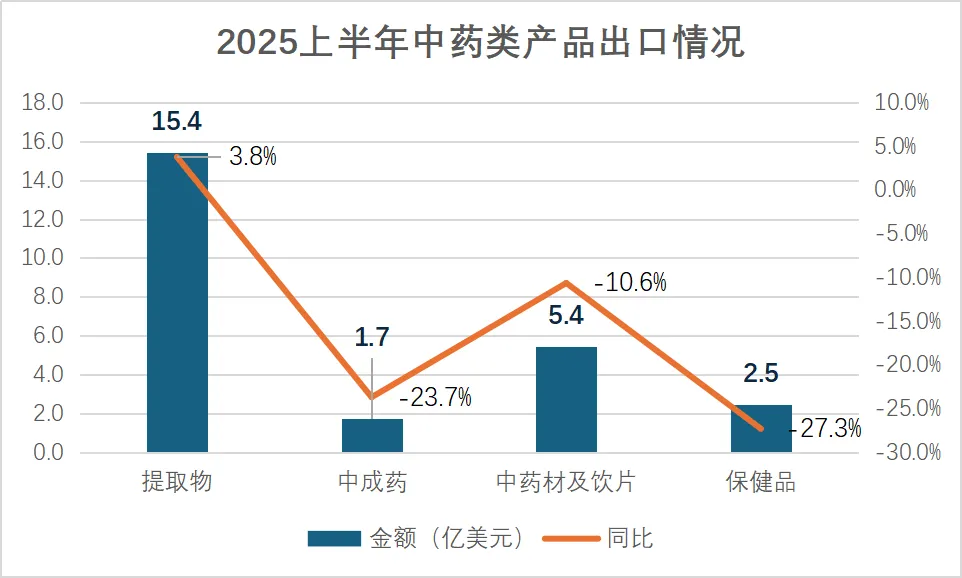
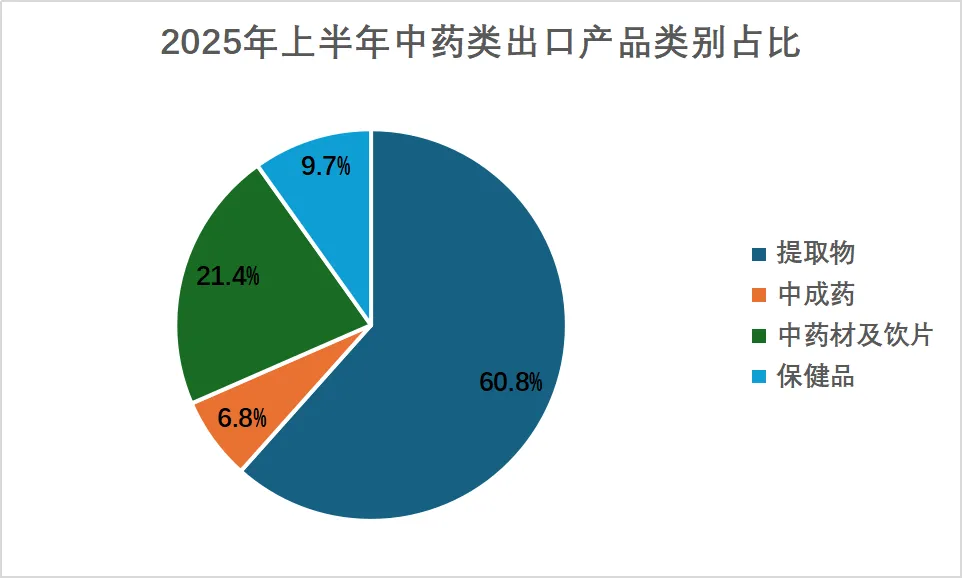
En la primera mitad de 2025, las exportaciones chinas de productos de medicina tradicional china totalizaron 2.540 millones de dólares, lo que supone un descenso del 5,61% en comparación con los 2.690 millones de dólares del mismo período del año pasado. De hecho, en los últimos años, las importaciones comerciales de medicina tradicional china han estado creciendo rápidamente, mientras que el crecimiento de las exportaciones se ha ido ralentizando gradualmente, e incluso las exportaciones entraron en una tendencia de crecimiento negativo en 2023 y 2024, cayendo respectivamente un 3,11% y un 2,71%. Esto indica que el comercio exterior chino de productos de medicina tradicional china ha pasado gradualmente de estar impulsado por las exportaciones de extractos vegetales, representativos de los productos básicos, a depender principalmente de las importaciones de hierbas medicinales chinas, también consideradas productos básicos. En el futuro, la importación de materias primas de alta calidad para medicina china será la tendencia dominante en el comercio exterior de este sector.
Extractos vegetales
Los extractos vegetales, que constituyen el pilar principal de las exportaciones de productos de medicina tradicional china, alcanzaron los 1.540 millones de dólares en la primera mitad de 2025, lo que representa un aumento del 3,81% interanual, revirtiendo así la caída del 14,51% observada en el mismo período del año pasado. Desde el punto de vista de los principales mercados de exportación, Estados Unidos, India y Japón ocupan los tres primeros lugares en las exportaciones chinas de extractos vegetales durante el primer semestre del año. Estados Unidos se mantiene estable como el mayor mercado para las exportaciones chinas de extractos vegetales, superando ampliamente a otros países y regiones; además, los extractos vegetales producidos en China son ampliamente utilizados en la fabricación de sus suplementos dietéticos. En la primera mitad de 2025, las exportaciones chinas de extractos a Estados Unidos alcanzaron los 320 millones de dólares, lo que representa un incremento interanual del 7,71%, constituyendo el 20,91% del total de las exportaciones chinas de extractos. Los mercados clasificados en segundo y tercer lugar, Japón e India, registraron exportaciones cercanas a los 150 millones de dólares cada uno. Durante los últimos tres años (2022-2024), las exportaciones chinas de extractos a Japón han mantenido una tendencia constante de crecimiento; en la primera mitad de este año, las exportaciones chinas de extractos a Japón aumentaron un 15,91% interanual, alcanzando un valor de 153 millones de dólares. Por otro lado, el mercado indio ha seguido mostrando un crecimiento sostenido en las exportaciones globales de extractos chinos durante los últimos tres años (2022-2024), pasando de representar el 5,31% al 9,01%. En la primera mitad de este año, las exportaciones chinas de extractos a India aumentaron un 13,81% interanual, alcanzando un valor de exportación de 156 millones de dólares, debido principalmente a que las exportaciones de oleorresina aumentaron bruscamente en un 98,51% en comparación con el mismo período del año pasado.
Desde el punto de vista de la segmentación, el mentol, el extracto de stevia, el aceite esencial de cítricos, el extracto de Citrus sinensis, el aceite de eucalipto, el extracto de silimarina, el extracto de ginkgo biloba, el extracto de regaliz y otras grandes variedades son las principales fuerzas que impulsan las exportaciones de extractos animales y vegetales. Entre ellas, las exportaciones del año pasado crecieron a una alta tasa del 36,81%, mientras que en la primera mitad de este año, la tasa de crecimiento de las exportaciones se desaceleró significativamente, aumentando un 5,41% interanual, con un valor de exportación de aproximadamente 100 millones de dólares.
Hierbas medicinales chinas y comprimidos para beber
En la primera mitad de 2025, el desempeño exportador de las hierbas medicinales chinas y los comprimidos para beber fue ligeramente lento, con un valor de exportación que ascendió a 540 millones de dólares, lo que representa una disminución del 10,61% interanual. De hecho, debido a la creciente demanda interna de hierbas medicinales chinas y a la débil demanda en el mercado internacional, las exportaciones chinas de hierbas medicinales y comprimidos para beber ya habían caído un 6,71% y un 5,81% en 2023 y 2024, respectivamente, mostrando en general una lenta contracción.
En cuanto a los mercados de exportación, el mercado asiático sigue siendo el principal destino de las exportaciones chinas de hierbas medicinales y comprimidos en la primera mitad de 2025. Japón, Corea del Sur, Taiwán, China, Hong Kong y Vietnam ocupan los cinco primeros lugares en las exportaciones chinas de hierbas medicinales y comprimidos, representando conjuntamente el 65,71% del mercado. Durante los últimos tres años (2022-2024), las exportaciones chinas de hierbas medicinales y comprimidos a Japón han continuado creciendo, con tasas de crecimiento anuales del 11,41%, 15,41% y 5,81%, respectivamente. En la primera mitad de este año, Japón se mantuvo como el mayor mercado de exportación de hierbas medicinales y comprimidos en China, con exportaciones que alcanzaron los 130 millones de dólares, aunque representaron una caída del 20,31% en comparación con el mismo período del año pasado, ocupando el 23,31% del mercado; dentro de estas exportaciones, las ventas de Semen Xanthi disminuyeron un 17,31% respecto al mismo período del año pasado. Las exportaciones a Corea del Sur cayeron un 3,91% en 2023 y un 2,01% en 2024, respectivamente. En la primera mitad de este año, las exportaciones chinas de hierbas medicinales y rodajas a Corea del Sur volvieron a disminuir un 6,61% interanual, alcanzando un valor de 68,9 millones de dólares y representando el 12,71% del mercado; esta caída se debió principalmente a una importante reducción del 47,81% en las exportaciones de vellosidad de cuerno de ciervo y su polvo en comparación con el mismo período del año pasado. Las exportaciones a Hong Kong, China y Taiwán, China fueron de alrededor de 60 millones de dólares, con caídas del 2,51% y del 13,41%, respectivamente.
ASEAN, como el importante mercado regional tradicional de China para las hierbas medicinales y comprimidos, ha visto cómo sus exportaciones chinas continuaron disminuyendo a un ritmo elevado desde 2023, con caídas del 20,31% y del 30,51% en los últimos dos años. Entre ellos, Vietnam registró una disminución significativa, llegando el valor de sus exportaciones en 2024 a solo el 38,51% del registrado en 2022. En la primera mitad de este año, las exportaciones del país a ASEAN alcanzaron los 100 millones de dólares, lo que representa apenas el 27,61% del valor anual de exportación en 2022, y también mostraron una caída del 2,61% en comparación con el mismo período de 2024. Tres de los cinco principales países con mayores exportaciones han experimentado crecimiento negativo: Vietnam, Malasia y Singapur; entre ellos, Vietnam registró en 2025 una caída interanual del 14,41% en la primera mitad del año, principalmente debido a que las exportaciones de bayas de goji cayeron drásticamente en un 52,21% en comparación con el mismo período del año pasado. Sin embargo, al mismo tiempo, vale la pena destacar que en la primera mitad de 2025, las exportaciones chinas de hierbas medicinales y comprimidos a Camboya, Myanmar y Laos mostraron un crecimiento excepcionalmente alto, aunque el valor total de las exportaciones no fue muy grande, el incremento llegó a ser del 196,61%, 683,31% y 168,91%, respectivamente.
From the perspective of segmentation, in the first half of 2025, the top five varieties of Chinese herbal medicines and tablets exported from China were cinnamon, wolfberry, ginseng, angelica and betel nut. Cinnamon and wolfberry fell 34.3% and 3.3% respectively in 2024, while ginseng and angelica grew 3.1% and 25.0% respectively in 2024, but in the first half of this year, the exports of these four varieties fell to varying degrees.Since 2020, China’s exports of betel nut have continued to grow at an ultra-high rate, with the export value growing from $226,000 in 2020 to 19.51 million U.S. dollars, the average annual compound growth rate of up to 143.9% during the five years. 2025, the first half of the year, betel nut exports continued to grow 114.5% year-on-year, exports amounted to 18.86 million U.S. dollars, only the first half of the year exports reached 96.7% of last year’s annual exports from last year’s fifteenth largest export varieties of the position of the fifth position jumped up to the momentum of export growth is still strong.
Proprietary Chinese Medicines
In the first half of 2025, China’s exports of proprietary Chinese medicines amounted to only 170 million U.S. dollars, down significantly from 230 million U.S. dollars in the same period last year, a drop of 23.7%. From the perspective of export market, the top five export markets of pCms are Hong Kong, China, Nigeria, the United States, Macao, China and Indonesia. Hong Kong, China is still the largest export market, exports of 60.11 million U.S. dollars, compared with the same period last year, down 42.4%, market share of 35%. The top five export markets, only the United States and Macao, China, to achieve positive growth, respectively, compared with the same period last year, an increase of 9.9% and 44.3%, exports to Indonesia, Nigeria, respectively, fell 35.4% and 12.5%.
From the perspective of segmentation, the main export products of pCms are classic varieties such as Pientzehuang, Qingliang Oil, Angong Niuhuang Pill and Baiyao. Among them, Qingliang Oil, Angong Niuhuang Pill, Chinese medicinal wine and Baiyao realized different degrees of growth, and Angong Niuhuang Pill and Baiyao grew significantly by 106.9% and 125.0% respectively. The export of Pientzehuang, on the other hand, dropped 70.3% year-on-year, especially the export to Hong Kong, China and Canada dropped 98% and 100% year-on-year respectively.
Health Care Products
At present, health care products are special in the customs statistics system, mainly including fish oil and cod liver oil, bee products and bird’s nest, vitamins and mineral preparation products are not counted. In addition, many health care products are exported in the form of food, which is also not included under health care products. The data on trade in health care products in this paper are incomplete statistics.
In 2023 and 2024, China’s exports of health care products achieved an increase of 42.2% and 20.9%, respectively, and in the first half of 2025, exports decreased by 27.3% year-on-year, with an export value of 250 million U.S. dollars. In terms of export markets, the U.S., South Korea, Australia, Canada and Chile are the top five markets for health care exports, with exports to the U.S., Australia and Chile declining by 22.4%, 38.4% and 80.3% respectively, which is the main factor for the overall decline in health care exports. Exports to South Korea and Canada, on the other hand, grew by 4.8% and 5.6% respectively, but the growth rate was significantly lower than that of 46.6% and 78.1% in the same period in 2024.
From the point of view of segmentation, the main export products of health care products for fish oil and cod liver oil, bee products and bird’s nest, etc., of which bird’s nest exports in the first half of this year grew as high as a staggering 4,140.9%, mainly due to the substantial growth in exports to Malaysia, China Macao, Hong Kong, China.
Imports
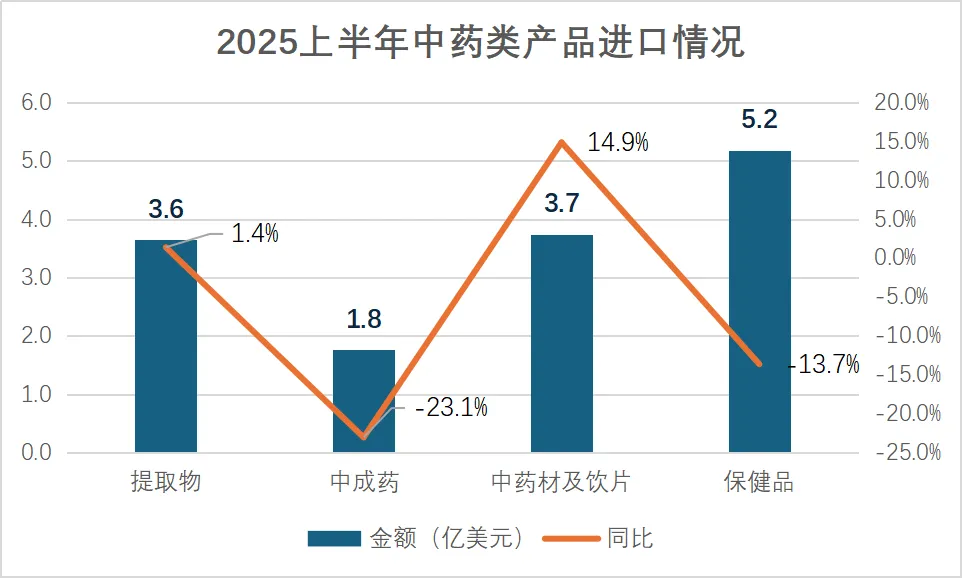
In the past five years, China’s imports of traditional Chinese medicine products have been on an overall expanding trend, with total imports growing from US$1.66 billion in 2020 to US$3.10 billion in 2024, representing a compound annual growth rate of 16.9%. However, in the first quarter of 2025, imports of Chinese medicine products declined by 8.4% year-on-year, and in the first half of 2025, they also dropped by 5.2% compared with US$1.51 billion in the same period last year, with total imports amounting to US$1.43 billion.
Plant Extracts
In the first half of 2025, the import value of plant extract products amounted to 360 million U.S. dollars, an increase of 1.4% year-on-year, a slight decline from the same period last year’s growth rate of 7.6%, but the overall trend is still rising.
From the perspective of import market, in the first half of 2025, China’s plant extract products imported the top three markets are India, the United States, Brazil. India is the largest source of imports of plant extracts in China, accounting for 18.7% of the market share, imports of 68.04 million U.S. dollars, but compared with the same period last year fell by 16.2%, of which menthol imports fell by 9.3% compared with the same period last year. The United States ranked as the second largest source of imports of plant extracts in China, with imports of 61.34 million U.S. dollars, an increase of 4.9% year-on-year, the same period last year, 1.5% negative growth has rebounded, mainly due to the imports of orange oil over the same period last year, a sharp rise of 30.8%. Brazil in 2024 with a substantial growth of 57.1% ranked China’s seventh largest source of plant extract imports, imports of 28.67 million U.S. dollars. In the first half of this year, China’s imports of extracts from Brazil rose sharply by 85.9% over the same period last year, with imports amounting to $30.41 million, already exceeding the level of the whole year of 2024, of which imports of orange oil rose sharply by 71.6% over the same period last year. In addition, China’s imports of extracts from Uzbekistan in 2024 showed explosive growth, with a growth rate of 84.1%, the first half of 2025 is 33.7% lower than the same period last year, imports of only $ 18.19 million, only up to the level of 33.6% of last year, mainly due to the imports of licorice liquid juice and extracts fell sharply by 57.8% compared with the same period last year.
From a segmentation point of view, essential oil products are the mainstay of imports, menthol, orange oil, peppermint oil, lemon oil, white lemon oil, peppermint oil, cinnamon oil and other essential oils accounted for nearly 50% of the first half of 2025 extract imports.
Chinese herbal medicines and tablets
Over the past five years, imports of Chinese herbal medicines and tablets have continued to grow, from $282 million in 2020 to $645 million in 2024. imports of Chinese herbal medicines and tablets products grew steadily again in the first half of 2025, with imports reaching $370 million, a year-on-year increase of 14.9%.
In terms of import markets, the top five import markets for Chinese herbal medicines and tablets in the first half of 2025 were Indonesia, Canada, New Zealand, Myanmar and South Korea. Indonesia continued to be the top importer of Chinese herbal medicines and tablets from China, with imports reaching US$95.19 million, up 76.8% from the same period last year, occupying 25.5% of the market share and far exceeding other markets, mainly due to a substantial increase of 102.7% in imports of cardamom from the same period last year. China’s imports of Chinese herbal medicines and tablets from Canada fell by 36.2% in 2024, ranking the sixth largest source of imports, but in the first half of this year rose sharply by 95.2% year-on-year, with imports amounting to 57.1 million U.S. dollars, which has already exceeded last year’s annual total imports and climbed up to the second position, mainly due to the imports of American ginseng, which rose sharply by 97.2% compared with the same period of last year. China’s imports of Chinese herbal medicines and tablets from New Zealand increased by 13.1% year-on-year in 2024, but fell by 18.7% year-on-year in the first half of this year, with the import value amounting to only 46.77 million U.S. dollars, mainly due to the import of antler velvet and its powder dropping by 18.8% compared with the same period last year. Imports from Myanmar and South Korea amounted to US$29.5 million and US$24.47 million respectively, up 1.6% and 31.6% from the same period last year.
In terms of segmentation, the main imported categories are American ginseng, antler velvet, cardamom, nutmeg, cloves and ginseng, etc., which are mainly domestic scarce or precious and fine medicinal herbs. The varieties with large increase in imports include American ginseng, cardamom and saffron.
Proprietary Chinese Medicines
In 2024, China’s imports of proprietary Chinese medicines amounted to USD 470 million, a year-on-year increase of 9.6%, but in the first half of this year, the year-on-year decline of 23.1%, with imports amounting to only USD 180 million. From the perspective of the import market in the first half of 2025, Hong Kong, China, Germany and Taiwan are the top three markets for imports of proprietary Chinese medicines products. 260 million U.S. dollars of proprietary Chinese medicines were imported from Hong Kong, China, in 2024, occupying 55.3% of the market, and imports in the first half of this year amounted to 110 million U.S. dollars, a year-on-year decline of 15.0%, but the market share expanded to 64%. The second largest import market is Germany, with imports of $30.74 million, down 56.4% compared to the same period last year, and a shrinking market share of 17.5%, but its year-on-year growth in 2024 was a whopping 25.9%, with a market share of 30.1%. Imports from Taiwan, China are different, on the basis of 32.9% year-on-year growth in 2024, a sharp increase of 140.7% in the first half of this year, imports reached 17.65 million U.S. dollars, has reached the level of 86.1% of the whole of last year.
Health care products
In 2024, China’s imports of health care products amounted to US$1.27 billion, a year-on-year increase of 9.9%, and imports amounted to 66,000 tons, a significant increase of 52.7%, which can be seen in the domestic consumer’s strong demand for health care products. However, in the first half of 2025, imports of health care products fell 13.7% year-on-year, with imports amounting to $520 million, reaching only 40.9% of last year’s annual level.
From the perspective of import market, in the first half of 2025, the top three markets for health care imports were Indonesia, Malaysia and Peru, accounting for 61.1% of total imports, with a high degree of import concentration. Indonesia steadily ranked as the largest source country for imports, with imports amounting to USD 180 million, a year-on-year decrease of 17.2%, mainly due to a significant drop in the imports of bird’s nests compared to the same period last year. Imports from Malaysia amounted to US$73.21 million, down 33.9% compared with the same period last year, mainly due to the sharp decline in imports of bird’s nest and fish oil products. Notably, imports from Peru amounted to US$61.85 million, a staggering year-on-year increase of 5,418.9%, mainly due to the ultra-substantial growth in imports of fish oil (except cod liver oil).
In terms of segmentation, bird’s nest and fish oil are the largest varieties of imports, far exceeding other categories, with imports in the first half of the year amounting to US$250 million and US$240 million respectively, accounting for 48.9% and 46.3% of the imports of health care products, but down 21.1% and 5.9% respectively compared with the same period last year. Seal oil is the third largest species, imports of 17.84 million U.S. dollars, an increase of 21.1% over the same period last year.

Plant Extracts
In the first half of 2025, the import value of plant extract products amounted to 360 million U.S. dollars, an increase of 1.4% year-on-year, a slight decline from the same period last year’s growth rate of 7.6%, but the overall trend is still rising.
From the perspective of import market, in the first half of 2025, China’s plant extract products imported the top three markets are India, the United States, Brazil. India is the largest source of imports of plant extracts in China, accounting for 18.7% of the market share, imports of 68.04 million U.S. dollars, but compared with the same period last year fell by 16.2%, of which menthol imports fell by 9.3% compared with the same period last year. The United States ranked as the second largest source of imports of plant extracts in China, with imports of 61.34 million U.S. dollars, an increase of 4.9% year-on-year, the same period last year, 1.5% negative growth has rebounded, mainly due to the imports of orange oil over the same period last year, a sharp rise of 30.8%. Brazil in 2024 with a substantial growth of 57.1% ranked China’s seventh largest source of plant extract imports, imports of 28.67 million U.S. dollars. In the first half of this year, China’s imports of extracts from Brazil rose sharply by 85.9% over the same period last year, with imports amounting to $30.41 million, already exceeding the level of the whole year of 2024, of which imports of orange oil rose sharply by 71.6% over the same period last year. In addition, China’s imports of extracts from Uzbekistan in 2024 showed explosive growth, with a growth rate of 84.1%, the first half of 2025 is 33.7% lower than the same period last year, imports of only $ 18.19 million, only up to the level of 33.6% of last year, mainly due to the imports of licorice liquid juice and extracts fell sharply by 57.8% compared with the same period last year.
From a segmentation point of view, essential oil products are the mainstay of imports, menthol, orange oil, peppermint oil, lemon oil, white lemon oil, peppermint oil, cinnamon oil and other essential oils accounted for nearly 50% of the first half of 2025 extract imports.
Chinese herbal medicines and tablets
Over the past five years, imports of Chinese herbal medicines and tablets have continued to grow, from $282 million in 2020 to $645 million in 2024. imports of Chinese herbal medicines and tablets products grew steadily again in the first half of 2025, with imports reaching $370 million, a year-on-year increase of 14.9%.
In terms of import markets, the top five import markets for Chinese herbal medicines and tablets in the first half of 2025 were Indonesia, Canada, New Zealand, Myanmar and South Korea. Indonesia continued to be the top importer of Chinese herbal medicines and tablets from China, with imports reaching US$95.19 million, up 76.8% from the same period last year, occupying 25.5% of the market share and far exceeding other markets, mainly due to a substantial increase of 102.7% in imports of cardamom from the same period last year. China’s imports of Chinese herbal medicines and tablets from Canada fell by 36.2% in 2024, ranking the sixth largest source of imports, but in the first half of this year rose sharply by 95.2% year-on-year, with imports amounting to 57.1 million U.S. dollars, which has already exceeded last year’s annual total imports and climbed up to the second position, mainly due to the imports of American ginseng, which rose sharply by 97.2% compared with the same period of last year. China’s imports of Chinese herbal medicines and tablets from New Zealand increased by 13.1% year-on-year in 2024, but fell by 18.7% year-on-year in the first half of this year, with the import value amounting to only 46.77 million U.S. dollars, mainly due to the import of antler velvet and its powder dropping by 18.8% compared with the same period last year. Imports from Myanmar and South Korea amounted to US$29.5 million and US$24.47 million respectively, up 1.6% and 31.6% from the same period last year.
In terms of segmentation, the main imported categories are American ginseng, antler velvet, cardamom, nutmeg, cloves and ginseng, etc., which are mainly domestic scarce or precious and fine medicinal herbs. The varieties with large increase in imports include American ginseng, cardamom and saffron.
Proprietary Chinese Medicines
In 2024, China’s imports of proprietary Chinese medicines amounted to USD 470 million, a year-on-year increase of 9.6%, but in the first half of this year, the year-on-year decline of 23.1%, with imports amounting to only USD 180 million. From the perspective of the import market in the first half of 2025, Hong Kong, China, Germany and Taiwan are the top three markets for imports of proprietary Chinese medicines products. 260 million U.S. dollars of proprietary Chinese medicines were imported from Hong Kong, China, in 2024, occupying 55.3% of the market, and imports in the first half of this year amounted to 110 million U.S. dollars, a year-on-year decline of 15.0%, but the market share expanded to 64%. The second largest import market is Germany, with imports of $30.74 million, down 56.4% compared to the same period last year, and a shrinking market share of 17.5%, but its year-on-year growth in 2024 was a whopping 25.9%, with a market share of 30.1%. Imports from Taiwan, China are different, on the basis of 32.9% year-on-year growth in 2024, a sharp increase of 140.7% in the first half of this year, imports reached 17.65 million U.S. dollars, has reached the level of 86.1% of the whole of last year.
Health care products
In 2024, China’s imports of health care products amounted to US$1.27 billion, a year-on-year increase of 9.9%, and imports amounted to 66,000 tons, a significant increase of 52.7%, which can be seen in the domestic consumer’s strong demand for health care products. However, in the first half of 2025, imports of health care products fell 13.7% year-on-year, with imports amounting to $520 million, reaching only 40.9% of last year’s annual level.
From the perspective of import market, in the first half of 2025, the top three markets for health care imports were Indonesia, Malaysia and Peru, accounting for 61.1% of total imports, with a high degree of import concentration. Indonesia steadily ranked as the largest source country for imports, with imports amounting to USD 180 million, a year-on-year decrease of 17.2%, mainly due to a significant drop in the imports of bird’s nests compared to the same period last year. Imports from Malaysia amounted to US$73.21 million, down 33.9% compared with the same period last year, mainly due to the sharp decline in imports of bird’s nest and fish oil products. Notably, imports from Peru amounted to US$61.85 million, a staggering year-on-year increase of 5,418.9%, mainly due to the ultra-substantial growth in imports of fish oil (except cod liver oil).
In terms of segmentation, bird’s nest and fish oil are the largest varieties of imports, far exceeding other categories, with imports in the first half of the year amounting to US$250 million and US$240 million respectively, accounting for 48.9% and 46.3% of the imports of health care products, but down 21.1% and 5.9% respectively compared with the same period last year. Seal oil is the third largest species, imports of 17.84 million U.S. dollars, an increase of 21.1% over the same period last year.