


In recent years, China’s innovative pharmaceutical industry has continuously enhanced its comprehensive strength, steadily improved its R capabilities, and expanded its market scale. License-out transactions have repeatedly hit new highs, demonstrating formidable potential and developmental resilience while playing an increasingly vital role on the global stage. The innovative drug industry plays an irreplaceable role in driving technological innovation, optimizing industrial structures, elevating healthcare standards, and strengthening international cooperation within the industrial chain. It stands as a vital domain of new productive forces. How to propel China’s innovative drug industry toward higher-quality development and ensure its steady, long-term advancement onto the global stage is a question demanding profound consideration at present.
1、Comprehensive strength has steadily improved
Ranking has advanced to the forefront of the second tier globally
After years of development, China’s comprehensive strength in innovative drug development has risen to the forefront of the global second tier, with notable achievements in international collaboration.
The innovative drug market continues to expand.
According to data from institutions such as the Comprehensive Forward Industry Research Institute and Frost & Sullivan, China’s innovative drug market size grew from $132.5 billion in 2019 to $159.2 billion in 2024 (see Figure 1), maintaining a global share of approximately 15%. Forecasts indicate that by 2030, China’s innovative drug market is expected to exceed $300 billion, with its global share continuing to rise.

License-out hits new record high License-out Hits New Record High
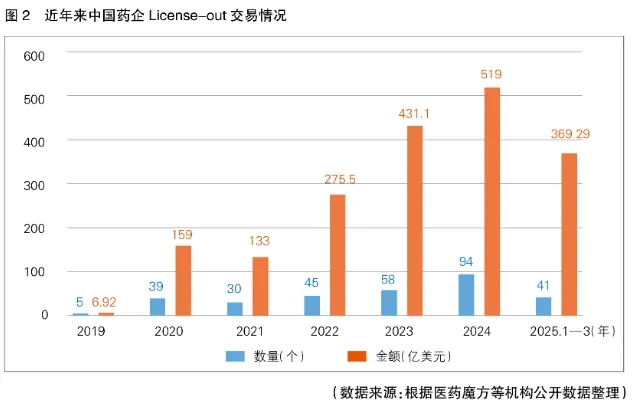
Pharm-X data reveals that in 2024, China completed 94 license-out transactions for innovative drugs, with total overseas deal value reaching $51.9 billion—a 26% year-over-year increase. From January to March 2025, China recorded 41 license-out deals totaling $36.929 billion, both figures setting new historical highs for the same period (see Figure 2).
Research and development capabilities continue to improve
Overall, China’s new drug R capabilities have reached the forefront of the global second tier. According to data from McKinsey, WuXi AppTec, and other institutions, China’s share of global drug pipelines under development rose to 26.7% in 2024, second only to the United States’ 49.1%. China ranks third globally in the number of new drugs approved for market launch annually, following the United States and Japan. The proportion of clinical trials conducted by Chinese companies in the global clinical trial landscape surpassed Europe in 2020 and overtook the United States in 2023, reaching 1,735 trials. This number exceeded 1,900 in 2024. Additionally, China and the United States lead the world in the number of clinical trials conducted in fields such as stem cell therapy and gene therapy.
The innovative drug sector continues to expand.
According to statistics from WuXi PharmaTech, from 2015 to 2024, innovative drugs under development globally covered 3,212 therapeutic areas. Among these, Chinese companies’ pipelines covered 1,300 therapeutic areas, representing a coverage rate of 40%. Chinese companies lead the development progress in 716 therapeutic areas (22%). In contrast, U.S. companies cover 1,689 therapeutic areas (53%), leading development progress in 1,212 areas (38%).
China’s Innovative Drugs Accelerate Their Lead
In recent years, China’s innovative pharmaceutical companies have demonstrated significant specialization and differentiated strategies across various therapeutic areas and technological approaches. Numerous pipelines and marketed products have achieved “China-first” and even “world-first” status (see table).

Innovative drug financing remains active
According to MoShan Investment and Financing data, in 2024, the global healthcare sector recorded a total of 3,007 investment and financing events. China accounted for 767 of these, ranking second only to the United States with 1,596 events. This figure significantly outpaced the United Kingdom (130 events), Canada (79 events), Switzerland (71 events), and Germany (48 events).
The innovative pharmaceutical industry cluster continues to develop.
As China’s innovative pharmaceutical industry continues to develop, it is gradually forming industrial clusters. For instance, the Beijing-Tianjin-Hebei Life Sciences Cluster has established a complete industrial chain encompassing technology R, clinical trials, testing and approval, manufacturing, and distribution. The Zhangjiang Biomedical Cluster in Shanghai has evolved into one of China’s key biomedical innovation hubs. Beijing has commenced construction of the International Medical Innovation Park, aiming to establish a global hub for pharmaceutical innovation collaboration. Additionally, multiple national-level biopharmaceutical clusters have emerged in regions such as Shandong, Jiangsu, and Guangdong. Leveraging local policy support, scientific research resources, and talent advantages, these clusters have generated significant industrial agglomeration effects, driving the rapid advancement of China’s innovative drug sector.
The overall profitability of the innovative drug industry has improved.
According to data from East Money Choice cited in a report by Securities Daily on April 26, among 98 A-share companies in the innovative drug sector, 62 have disclosed their 2024 annual reports, with 34 achieving year-on-year growth in net profit attributable to shareholders. This lays a solid foundation for better participation in international cooperation.
Rapid Advancement of Artificial Intelligence (AI) in Pharmaceutical Development
According to data from institutions such as the Comprehensive Forward-Looking Industry Research Institute and Frost & Sullivan, China has now become the world’s second most active country in medical AI transactions. By 2024, China’s AI healthcare market size has surpassed 15 billion yuan, with expectations of rapid growth exceeding 30% CAGR in the future. By the end of 2024, the number of AI-powered pharmaceutical companies in China had reached 105, marking the entry into the “era of 100 enterprises.” With the advancement of AI models like DeepSeek, many leading innovative drug companies in China are accelerating their AI-driven pharmaceutical initiatives.
2、Multiple factors converge to form a powerful synergy
Driving the upgrading of international cooperation
China’s international cooperation in innovative drug development has achieved new progress, rooted in the high-quality development of the nation’s pharmaceutical industry as a whole. This advancement stems from the combined effects of multiple factors, including policy support, capital investment, human resources, and industrial infrastructure.
The year 2015 marked a pivotal moment in China’s innovative drug development. New policies established a “green channel” for urgently needed innovative drugs, providing corresponding financial subsidies and shortening review and approval timelines. In 2017, China’s drug regulatory authorities formally joined the International Conference on Harmonisation of Technical Requirements for Registration of Pharmaceuticals for Human Use (ICH), gradually aligning China’s drug review technical requirements with international standards. In 2024, the Implementation Plan for Full-Chain Support of Innovative Drug Development, approved by the State Council executive meeting, along with corresponding supporting policies from various regions, further bolstered innovative drug development, injecting powerful momentum into the industry’s growth.
Recently, Beijing and Shenzhen—two major hubs for pharmaceutical innovation—simultaneously introduced policies supporting innovative drug development. These policies focus on comprehensive support across the entire innovation chain, including R support, clinical trial efficiency enhancement, accelerated review and approval, AI-enabled innovation, investment and financing support, and talent retention. This elevates the level of support for innovative drug development to new heights, providing additional backing for China’s international cooperation in innovative drugs and injecting fresh momentum into its development.
As a capital-intensive industry, innovative drug development relies heavily on substantial funding. Data from WuXi PharmaTech shows that from 2015 to 2024, China’s innovative drug sector raised a total of 1.23 trillion yuan from primary and secondary markets. Fueled by substantial capital inflows, a large number of Chinese innovative drug companies have gradually built robust product pipelines, launched multiple innovative drugs in domestic and international markets, and established an integrated innovation chain spanning “R-production-commercialization.”
A comprehensive and controllable pharmaceutical supply chain provides robust support for China’s innovative drug development. China is the world’s largest producer and exporter of active pharmaceutical ingredients (APIs), while also ranking among the top global producers and exporters of generic drugs, possessing industrial chain advantages that are difficult for other countries to replicate. In recent years, multinational pharmaceutical companies have continuously expanded their presence in the Chinese market. Beyond recognizing China’s development potential as the world’s second-largest pharmaceutical market, they increasingly rely on China’s well-established pharmaceutical supply chain to achieve their own strategic goals.
Moreover, China’s innovative drug development relies on its abundant human resources. Statistics show that China produces approximately 5.1 million STEM undergraduate graduates annually—surpassing India (around 2.9 million) despite both being populous nations, and far exceeding the United States (about 600,000), the most populous developed country. Furthermore, data from the National Health Commission indicates that China currently produces over 500,000 graduates annually with bachelor’s degrees or higher in medical fields, ranking among the world’s highest. This establishes a robust human resource foundation for innovative drug development. Simultaneously, factors such as patient recruitment advantages, human resource strengths, and lower operational costs at clinical trial institutions contribute to clinical trial costs in China being approximately one-third of those in Europe and the United States, offering a significant cost advantage.
3、Challenges Faced in the New Landscape
Upholding Independent Innovation and Diversified Development
The global pharmaceutical supply chain landscape is undergoing transformation. Against this backdrop, China’s innovative drug industry faces numerous challenges in advancing international cooperation.
Confronted with uncertainties in future development, Chinese innovative drug enterprises are recalibrating their direction and pathways for international collaboration. Building upon the domestic market foundation, adhering to a strategy of “independent innovation + diversified deployment” has become the industry’s shared choice and practical approach. Policy support, as a key internal driver for innovative drug development, should also be elevated to a strategic level. Efforts should be made across multiple dimensions to fully leverage the guiding, supporting, and empowering role of policies, thereby better assisting China’s innovative drug industry in deeper integration into the global pharmaceutical industry chain’s trend of convergence and development.
The “Implementation Plan for Full-Chain Support of Innovative Drug Development” has elevated policy support for innovative drugs to new heights. Supporting policies from relevant departments and local governments have been rolled out, empowering innovative drug companies in international cooperation through accelerated review and approval processes, financial incentives, adjustments to the medical insurance reimbursement list, and international collaboration support. Recently, the national government explicitly announced plans to establish an innovative drug directory and improve drug pricing mechanisms. This marks a significant step toward building a sustainable innovation ecosystem driven by pricing, focusing on creating a closed-loop cycle of “R-market launch-return-R” for innovative drugs.
The “Implementation Plan for Digital and Intelligent Transformation of the Pharmaceutical Industry (2025-2030)” issued by seven ministries, including the Ministry of Industry and Information Technology, proposes deepening the application of artificial intelligence. Support relevant entities in establishing pharmaceutical large-model innovation platforms to collaboratively develop pharmaceutical large-model technologies and products, conduct regulatory science research, and strengthen rule-making in areas such as standards, scientific ethics, application security, and risk management. Launch pilot programs for “AI-Empowered Pharmaceutical Full Industry Chain” applications, encouraging leading pharmaceutical companies to form consortia with medical institutions, research institutes, upstream/downstream enterprises, and major users to create a series of highly effective, landmark application scenarios across the entire pharmaceutical industry chain. Encourage localities to build public service platforms in the pharmaceutical AI sector, including concept verification, pilot testing, common technologies, intellectual property operations, and open-source communities.
The global healthcare governance system is undergoing restructuring, marked by a significant reduction in funding from major contributors. The digital and intelligent transformation of the pharmaceutical industry, driven by AI empowerment, is accelerating. China’s international cooperation in innovative drugs faces new challenges. In response, policy support for the international cooperation and development of the pharmaceutical industry can focus on the following four areas.
First, leveraging China’s strengths in outward-oriented pharmaceutical supply chain cooperation, we should proactively design healthcare cooperation agendas in multilateral and bilateral forums. This involves establishing more communication mechanisms and platforms to dismantle explicit and implicit barriers, enhance risk prevention and response capabilities, facilitate specific cooperative projects, and foster integrated development of domestic and international pharmaceutical supply chains.
Second, leveraging the “hard power” of China’s pharmaceutical supply chain, we must proactively cultivate “soft power” in multilateral and bilateral international cooperation scenarios—such as policy advocacy, regulatory collaboration, financing support, development assistance, and public welfare rescue platform development—from the perspective of China’s overall international development cooperation strategy. This will foster a more favorable environment for international cooperation among China’s innovative pharmaceutical enterprises.
Third, we must leverage China’s abundant pharmaceutical professional talent pool to cultivate a specialized workforce with international cooperation vision, extensive diplomatic experience, and solid expertise. This will lay a robust human foundation for China’s innovative pharmaceutical international collaboration.
[QWEN_MT_ITEM_1] 넷째, 중국의 고품질이며 가성비 뛰어난 의약품이 갖춘 '하드 파워'를 활용하여, 무역 파트너십, 투자 및 금융, 대외 원조 개발, 국제 공공 조달, 학술 컨퍼런스, 대표단 교류 등 다층적이고 다양한 경로의 협력 방식을 종합적으로 활용해 중국 의약품 기준의 가시성과 인지도, 수용도를 높여야 합니다. 이를 통해 중국 표준의 국제화를 위한 유리한 '소프트 환경'을 조성해야 합니다.